Skip to content
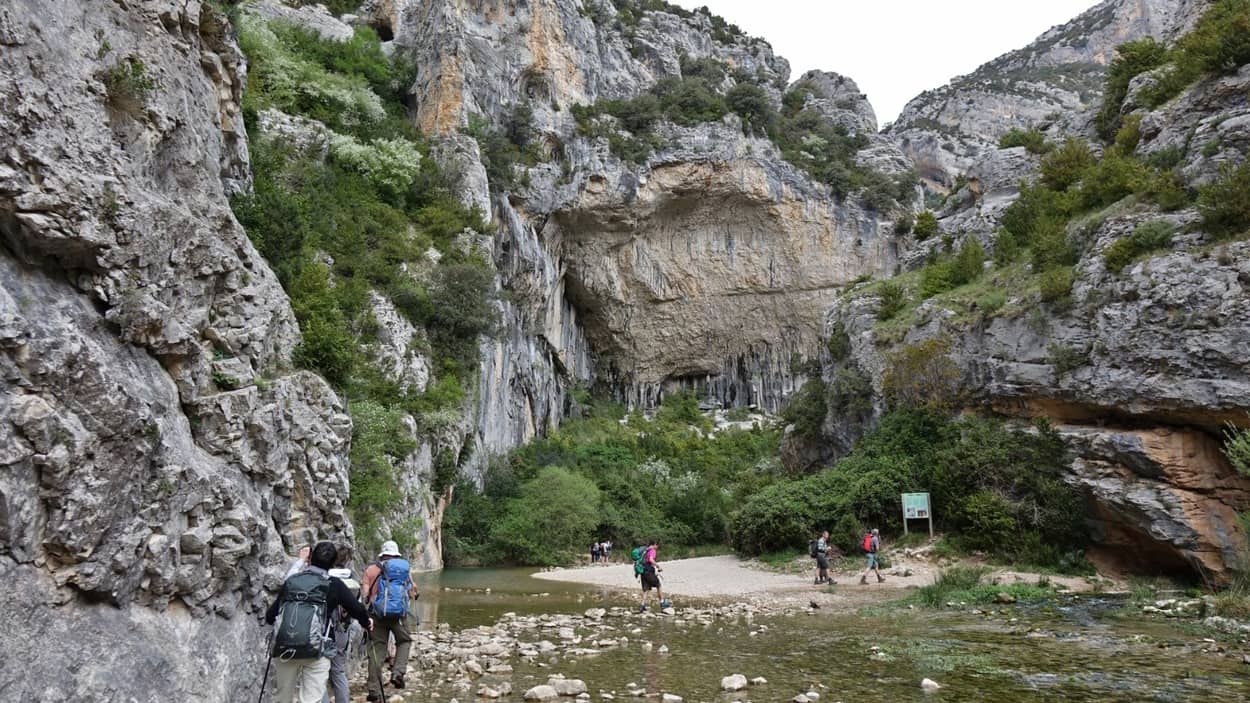
This is a paradise for birds of prey, here in the Sierra y los Cañones de Guara Natural Park. More and more people are even travelling halfway across the globe to see one of the world’s largest concentrations of birds of prey and scavengers.
It’s curious—perhaps just a matter of habit—but those who live in the Sierra de Guara see birds of prey and scavengers as part of the landscape. It’s only when we visit other places and look up at the sky that we miss the abundance of these giants of the air. Let’s get straight to the point: I’ll tell you what you’ll see here when you spot a swift shadow on the ground and look up.
The main birds of prey in the Sierra de Guara
The griffon vulture, king of the skies over Guara
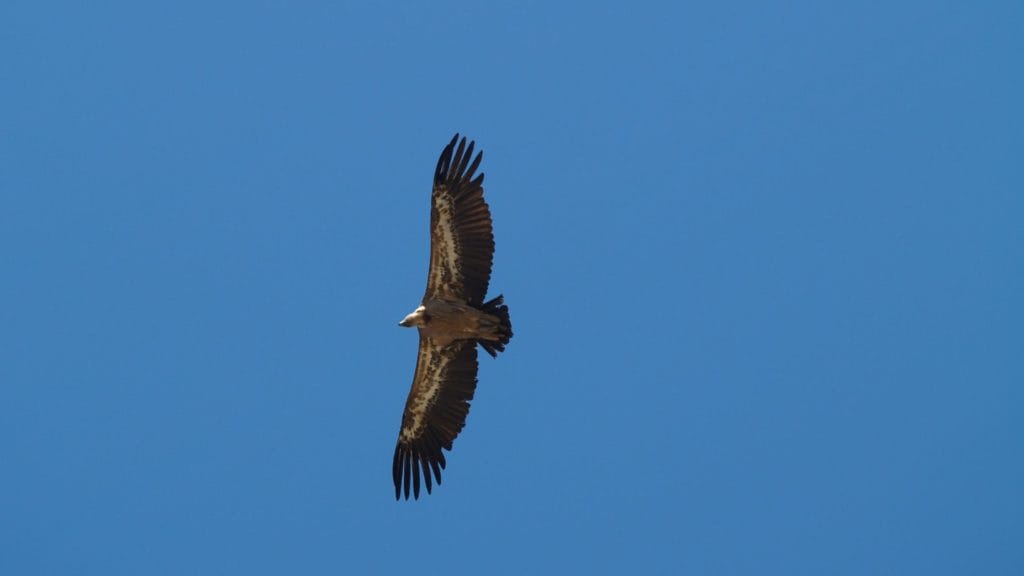
We begin our overview with the most abundant of all birds of prey in the protected area of Guara Park. Weighing almost 11 kilograms in the case of the largest females, with a wingspan well over two metres and a body length of up to 1.20 metres, the griffon vulture (Gyps fulvus) is the king of these skies.
The bearded vulture, Guara’s greatest ornithological treasure
We could devote an entire post to the courage, majesty and importance of the griffon vulture , which came to be in serious danger of extinction and now is the star of the park, but then we wouldn’t have time for the bearded vulture, which is the real star of the Sierra y los Cañones de Guara Natural Park. The bearded vulture (Gypaetus barbatus) has here its population most significant in Europe, in terms of numbers and in terms of conservation model of conservation, which has been underway since 2003 and which has enabled, not only to recover the species here but also to strengthen the populations of other territories where bearded vultures were found, – or are still found-, in serious danger.
The vulture, the Guara ballot paper
And we won’t leave the scavenger birds until I’ve told you that the Egyptian vulture, as the alimoche (Neophron percnopterus) is known here, completes the trio of this type of bird of prey. It is the smallest of the European vultures and usually spends the winter in Africa, returning in large numbers when spring arrives, between March and April.
Eagles, hawks and other iconic birds of prey
These three are the most striking and perhaps the most recognisable of all to the untrained eye, although those who enjoy birdwatching will find the sight of the golden eagle, the short-toed eagle or the Bonelli’s eagle far more rewarding. We mustn’t forget the speedsters of the skies: the peregrine falcon, with a top speed of up to 250 kilometres per hour; the sparrowhawk, the goshawk and the red kites, which, with their distinctive white patches under their wings, inhabit our mountains all year round.
When the warm weather arrives, they are joined by black kites, which spend the winter in Africa.
The kestrel, small but unmistakable
Near roads, it is common to see the smallest of the birds of prey, the kestrel. It is very easy to spot due to its hovering flight at low altitude, from which it watches for potential prey.
The protection of birds in the Sierra de Guara
In 1988, the Sierra de Guara was designated a ZEPA (Special Protection Area for Birds). The area was home to a wealth of birdlife, but there were endangered species that needed to be protected within the European Union’s Natura 2000 network.
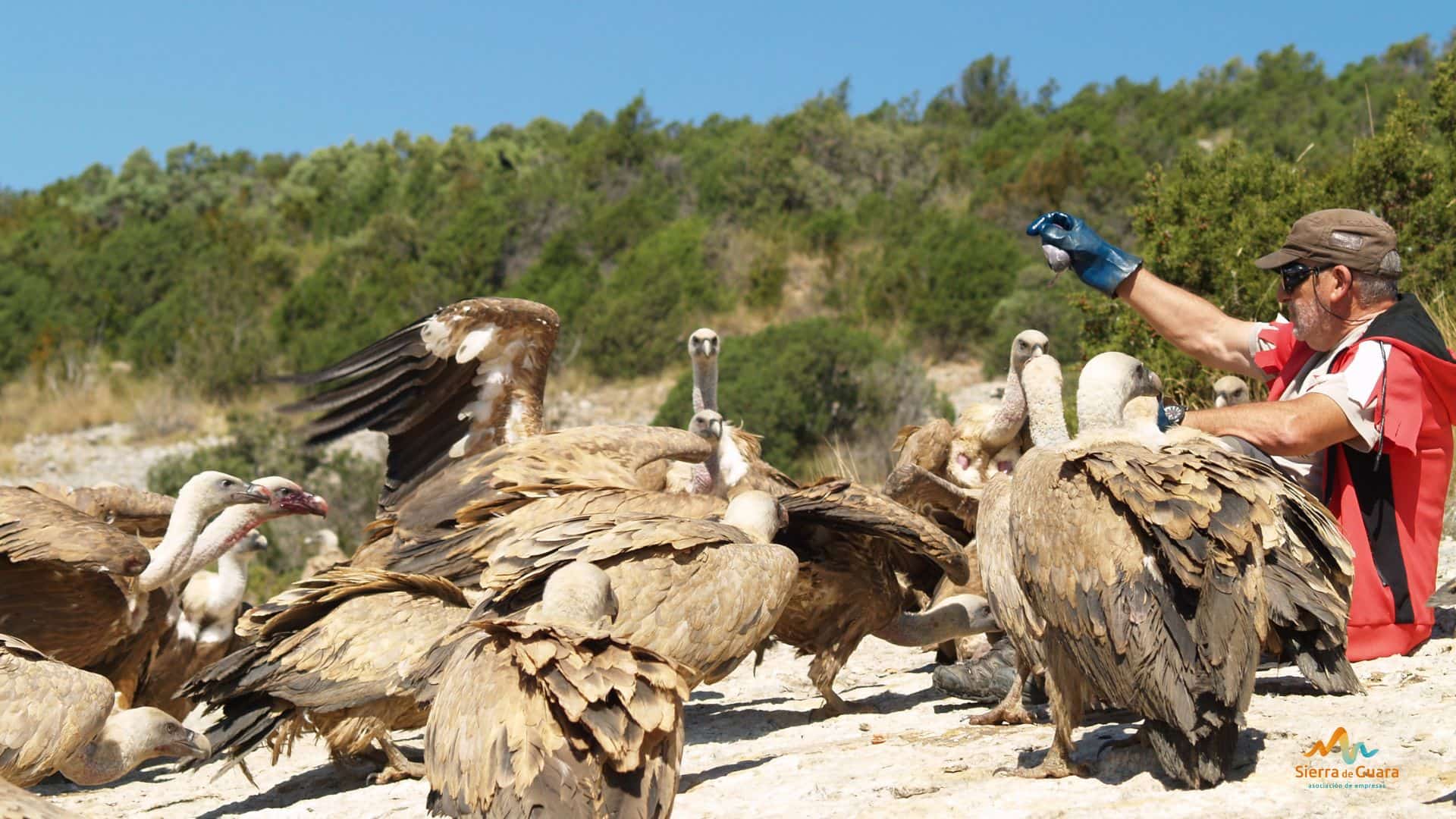
When discussing conservation, we must mention the Friends of the Vulture Fund, an organisation founded in the 1980s to protect, conserve and disseminate information and knowledge about scavenger birds. Currently, in Guara and the surrounding area, they manage five feeding stations: La Pedriza in Santa Cilia de Panzano and Las Sardas in Bierge, both in Guara; the feeding station in the Sierra de la Carrodilla, in Estadilla; Las Cuchillas, in Binaced; and the one in Naval. They also run the Casa de los Buitres Museum in Santa Cilia de Panzano, from where they organise activities, notably the feeding of vultures. If you would like to attend, it is best to book your place by emailing info@fondodeamigosdelbuitre.org.
The best birdwatching routes in the Sierra de Guara
Any spot in the Sierra y los Cañones de Guara Natural Park is ideal for birdwatching. With a pair of binoculars, you’ll have a wonderful time almost anywhere. However, there are a number of routes that are particularly special due to the high concentration of species and individual birds. If you’d like to view the map of activities in Guara, which includes birdwatching, click here.
If I had to recommend just one route, it would be number 5 of the birdwatching routes published by Turismo de Aragón. To follow this route, you’ll need to travel by car; it would even be brilliant to do it by bike. For this route, we’ll start in the centre of the park, in the village of Alquézar. If you look up in the village itself, it’s not unusual to see Egyptian vultures, griffon vultures or bearded vultures flying overhead.
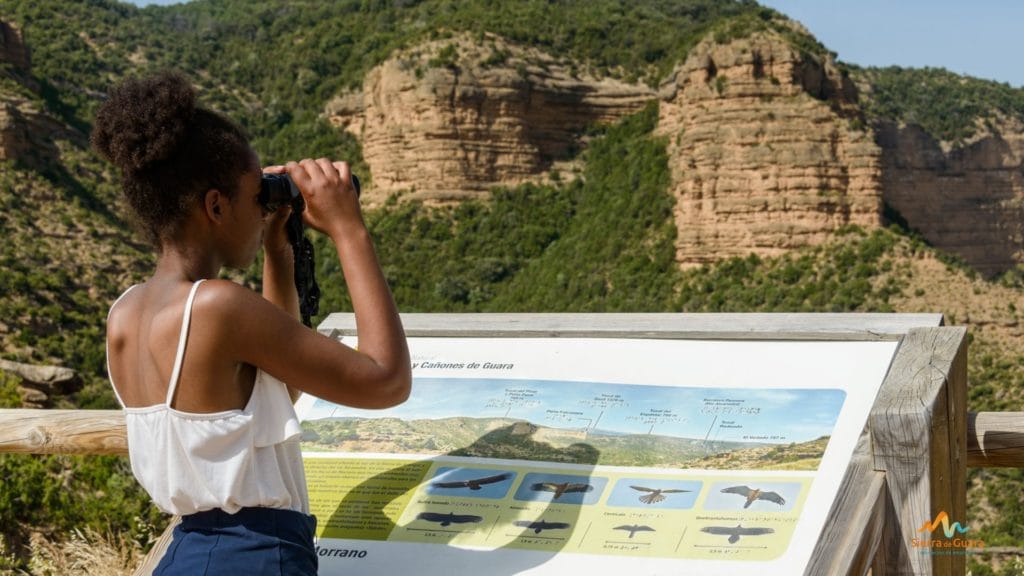
Or all at once! The next stop on this route takes us to Bierge, a crossroads and the starting point for various trails that wind through Guara. From the Huevo de Morrano viewpoint, you can spot Egyptian vultures, peregrine falcons, griffon vultures and golden eagles – and that’s just the birds of prey; there are many more species to be seen.
The route continues past the Calcón Dam and the Vadiello Reservoir, ending at the Salto de Roldán, where you can see all the species we’ve mentioned so far, with one added bonus: they have their nests right there, and if you look towards the Hoya de Huesca, you can watch them in majestic flight from above. It’s truly magical. If I’ve convinced you to try this route and you’d like to download it, it’s HERE.
Resources for birdwatching in Guara
The routes, the opportunities for birdwatching and for combining birdwatching-related activities are endless, so here are some extra resources to help you explore our rich birdlife in greater depth.
Discover the rich birdlife of the Sierra de Guara
And you know we’d love to hear that you’re visiting us or have already done so. If you post your photos and videos on social media using the hashtag #ViveGuara, it’ll make us very happy.
RESOURCES FOR BIRD WATCHING IN GUARA
Birdwatching on Guara.org: https://guara.org/actividades/ornitologia/
Friends of the Vulture Fund: https://fondoamigosdelbuitre.org/
Birdwatching in La Hoya de Huesca: https://turismo.hoyadehuesca.es/la-hoya-de-huesca/natural/aves-rapaces
Birdwatching in the Somontano: https://issuu.com/guarasomontano/docs/observacion_de_aves
Birdwatching routes in the Pyrenees: https://www.prepyr365.com/es/rutas/naturaleza/ornitologicas.html
Birding in Aragón. Birdwatching tourism: https://birdingaragon.com/
Balcés Ridges and Bierge Nature Trail: https://turismosomontano.es/images/RUTAS/ornitologia/fichas%20tecnicas/Bierge.pdf