Skip to content
What does sustainable tourism mean in the Sierra de Guara?
Sustainable Tourism: How we are reconciling tourism with sustainability in the Sierra de Guara Natural Park is the subject of research and a great deal of work.
That is why sustainable tourism is the only viable option here, in a region with stringent environmental protection measures which, from time to time, are worth explaining.
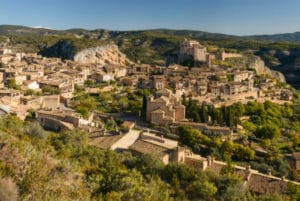
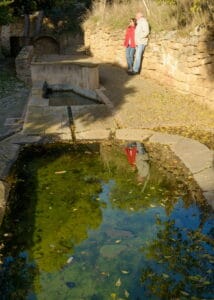
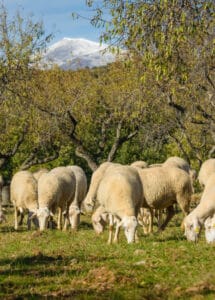
The Sierra y los Cañones de Guara Natural Park
Well, everything here is geared towards sustainability and ensuring that nature conservation goes hand in hand with the economic development of those of us who live within the natural park and its surrounding areas.
Here is all the information you need about the details and key facts regarding the Sierra y los Cañones de Guara Natural Park:
This story began in the 1970s, when the growing influx of visitors to the Sierra de Guara – who did not always show respect for the environment and nature – prompted the first calls for its preservation. This led, in the late 1980s, to the establishment of a natural park, which was finally designated a protected area in 1990: the Sierra y Cañones de Guara Natural Park was born.
In fact, it is not just the natural park that constitutes the protected area; there are also a further 33,286 hectares of the Peripheral Protection Zone, making it the largest protected natural area in Aragón.
The Sierra de Guara within the Natura 2000 network
And in two ways: as a Special Protection Area for Birds (SPA) and a Site of Community Importance (SCI).
In short, as you can see, the park is a European benchmark in this regard. How will you notice this as a visitor? Well, in the conservation and authenticity of the area. Birdwatching is one of the main attractions here, thanks to the variety and large numbers of birds, including scavengers, for whom this is their favourite habitat in Europe.
But when it comes to sustainability, there’s more to it than that, because it’s not all about animals and plants. UNESCO, the United Nations Educational, Scientific and Cultural Organisation, has recognised the extraordinary geological heritage of the Sierra de Guara area, situated on the border of the Sobrarbe region, by awarding it the title of
Guara. Mountains, gorges and rock formations
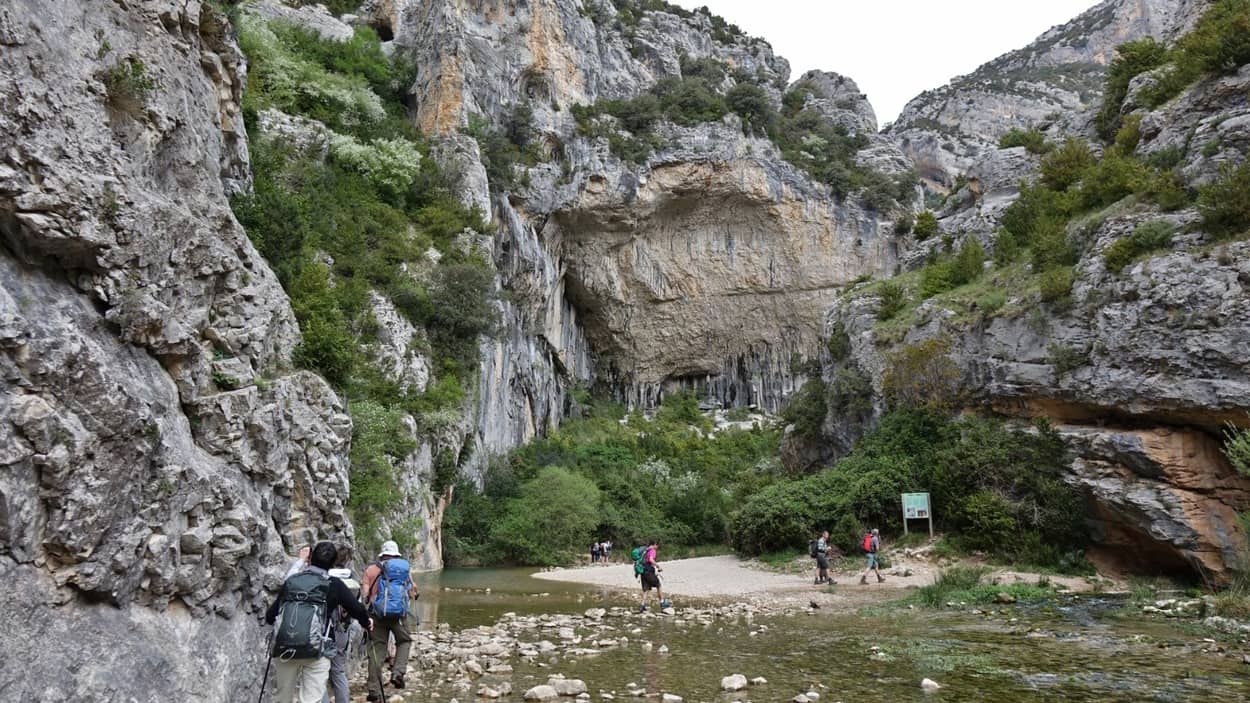
The name Guara means many things in Guara. The Natural Park takes its name from Guara, a mountain range some 15 km long that stretches from west to east between the Guatizalema and Alcanadre rivers, which we have mentioned here before when discussing canyoning.
At 2,077 metres, Mount Guara is the highest peak in the Sierra y los Cañones de Guara Natural Park.
If you’re interested in geology and have some knowledge of the subject, you’ll be able to see and understand what most of us simply admire as beautiful, and that will be an added bonus for you. Think of Guara as a gigantic rock, tens of kilometres across, which water and wind have carved and hollowed out over the millennia until it became what we enjoy today.
The rivers and gorges have become the main tourist attraction in this region, but they also hold great geological and environmental value.
The flora and fauna of Guara. Uniqueness and environmental frontier
Guara is home to a rugged and complex landscape and boasts an enormous wealth of flora and fauna. Pine forests are the dominant feature here, many of which date from the reforestation efforts of the mid-20th century; however, there are also oaks, gall oaks, holm oaks and kermes oaks, which are the plants that dominate the landscape, although in the shady areas on the north-facing slopes there are still specimens of fir, beech and even black pine.
The forests and remarkable trees of Guara
When it comes to trees, the ancient holm oak in Lecina deserves a chapter of its own. Or we could even devote a longer chapter to the remarkable trees found in this area. If you’re interested, just let me know.
The range of shrubs, plants, trees and exceptional examples of the plant kingdom is practically endless. As for wildlife, both ornithology and birdwatching have their own section on our website. The Sierra de Guara provides a refuge for a wide variety of animals.
The wildlife of the Sierra de Guara
Among the mammals, we can mention wild boar and roe deer; in fact, we recommend taking particular care on the park’s roads, especially from dusk until dawn, as it is quite common to spot them along the roadside.
The population of feral goats has continued to grow in recent decades, although there are many more mammals, such as foxes, stone martens, wildcats, badgers and even otters. There are traces in place names that refer to bears and wolves, although these are no longer found in the mountains today.
On many occasions, if we simply go for a walk without looking any deeper, we’ll still have a great time, though not quite as much as if we’d taken the trouble to gain a deeper understanding. To enjoy Guara, you don’t need to be an expert in anything; you just need to keep your eyes wide open. I’d like to share with you an episode of a podcast we dedicated some time ago to sustainability in Guara, in case you’d like to explore these issues in more depth:
Conservation also depends on those who visit Guara
Now you know about many of the things we still have in Guara, thanks to the fact that it is a sustainable and protected area. And that is down to the people who live here and have preserved all these values to this day.
And, of course, credit is also due to those of you who come here and leave everything in an even better state than it was before your visit to Guara.