Skip to content
The Sierra de Guara is home to many treasures. Some of these treasures are natural, but others bear witness to thousands of years of human presence in what is now the Sierra y los Cañones de Guara Natural Park.
At least 42,000 years ago, humans began to leave traces of their existence on the banks of the River Vero, the heartland of rock art in our region. Much later, in 1998, UNESCO recognised the Rock Art of the Mediterranean Arc of the Iberian Peninsula as a World Heritage Site, including, of course, all the remains found in the Sierra de Guara.
The best routes for exploring the rock art of Guara
What we’re suggesting today isn’t that you explore every single aspect of the cave art in the Sierra y los Cañones de Guara Natural Park, but rather that you choose what are perhaps the most interesting sites to visit.
We have taken into account not only the significance of each site, but also its accessibility and appeal when it comes to incorporating it into an enjoyable day out, even for families.
What types of cave paintings are there in the Sierra de Guara?
Before we start suggesting destinations, it makes sense to pause and put this wealth of World Heritage into context. As I mentioned at the start, there are remains dating back more than 40,000 years, and we can divide all the cave paintings into three distinct periods: Palaeolithic Art (between 40,000 and 10,000 BC), Levantine Art (between 8,000 and 3,000 BC), and Schematic Art (between 5,000 and 1,500 BC).
Most of the destinations we suggest you visit today date from the second and third periods, in order of age. As for the oldest cave paintings, you can take a look at what you’ll find in the Cueva de la Fuente del Trucho (LINK) https://parqueculturalriovero.com/es/arte-rupestre/arte-rupestre-en-el-rio-vero/arte-paleolitico
Colungo, the gateway to the rock art of Guara
Colungo is your starting point, whether you want to explore the rock art in the Sierra y los Cañones de Guara Natural Park in depth, are looking for a guided tour of the highlights of the rock-shelter sites, or want to enjoy some family fun with the activities on offer at the Colungo Rock Art Centre.
Here, we can enjoy a journey through 20,000 years of human history in the Vero region, with both an exhibition and a range of activities on offer.
The exhibition at the Colungo Rock Art Centre is divided into three parts: the House Museum, where you will be given an overview of rock art; the archaeological park, where you can see life-size prehistoric structures; and the Fuente del Trucho Cave Exhibition Space, where, through a variety of displays, you will learn about the lives of the people who left their mark on the only Palaeolithic cave in Aragon.
If you’d like more information about everything you’ll find at the Colungo Rock Art Centre, here’s the post we’ve dedicated to it, along with their contact details (LINK)

The must-see rock shelters of the Sierra de Guara
Chimiachas, Quizáns and Regacéns in the Vero Gorge
Almost all the rock-art sites are open to visitors, though based on accessibility, the beauty of the surroundings and their state of preservation, we’ve selected a few that you’ll enjoy visiting, whether on foot or even as part of your cycle route.
One of the busiest routes in our Bguara region—the one that runs through the Vero River Canyon—takes you right past the rock shelters of Chimiachas, Quizáns and Regacéns. In fact, if you’d like your bike ride to offer more than just cycling and stunning scenery, we invite you to stop off at each of these points of interest.
This is a one-way route of just over 26 kilometres which you can start in Asque or Alquézar and which we recommend doing in winter, spring or autumn. Here is the route: https://bguara.com/ruta/enduro/canon-del-rio-vero/
Arpán’s coat
If you prefer to walk, don’t miss the Arpán ravine. To get there, take the A-2205 towards Arcusa; once you’ve passed the turn-off for Asque, you’ll find the car park where the footpath starts. It’s a 2.6-kilometre round trip with a 120-metre elevation gain, which you can complete in an hour. In this rock shelter you’ll find depictions of deer, quadrupeds and archers in a Levantine and schematic style. If you fancy a go, it’s this way https://turismosomontano.es/es/que-ver-que-hacer/aventura/senderismo/rutas-en-la-sierra-de-guara/ruta-al-abrigo-de-arpan

Lecina Superior and Barfaluy
Lecina, in the Sobrarbe region, is the starting point for exploring two other key sites of schematic rock art in the Sierra y los Cañones de Guara Natural Park: Lecina Superior and Barfaluy.
The route, which is clearly signposted and well-defined, is slightly longer than the previous one, covering a distance of 2.2 kilometres one way, with an elevation gain of 144 metres. In total, it is just under 4.5 kilometres of easy walking with plenty of charm. The highlight of the route is the opportunity to see figures of animals and humans, as well as some symbols and schematic paintings.
As well as the rock art and the scenery, you can visit the village of Lecina and its famous holm oak. If this sounds like something for you, click here LINK
The Mallata shelters and the Mirador del Vero
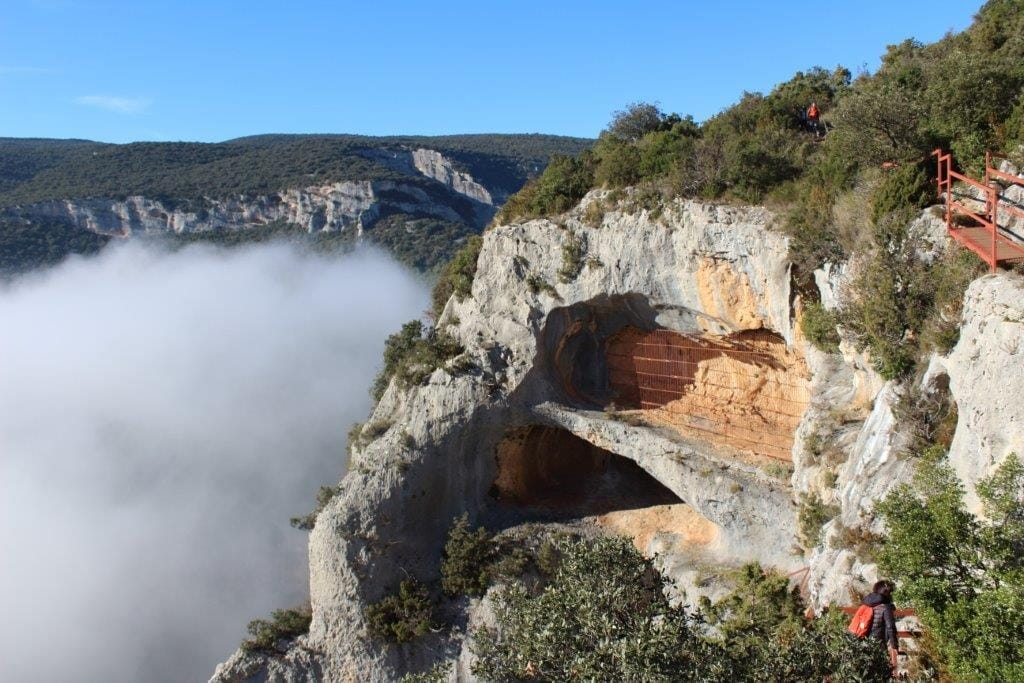
We cannot leave the area without visiting the most striking site of all, as the Mallata rock-shelter complex appears to hang from the cliffs of the Vero. To reach them, we will set off from the Mirador del Vero viewpoint, also on the A 2205 between Arcusa and Aínsa, 11 kilometres from Colungo.
It will take just over 20 minutes to take in the scenery stretching from the depths of the Vero Gorge to the peaks of the Pyrenees. The paintings depict people with tethered deer, various animals, symbols, people wearing hats, and what may be a wild boar, amongst other subjects. Needless to say, you’ll enjoy it all the more in the company of professional guides.
Click here if you’d like to be amazed by the landscapes of El Vero and the rock shelters of Mallata: https://parqueculturalriovero.com/es/actividades/visitas-guiadas-al-arte-rupestre/mallata
Beyond the paintings: the dolmens of Guara
And we’re not just talking about cave paintings – which would be quite something in itself – but, if we broaden our focus, we find the quintessential funerary monument in our region: the dolmens.
The best known are: the one at Losa Mora https://guara.org/arte-rupestre/dolmen-de-la-losa-mora/, near Rodellar and on the path to the Mascún ravine; the Cienfuens dolmen https://bguara.com/ruta/enduro/dolmen-de-belsue/, accessible from the westernmost part of the Sierra y los Cañones de Guara Natural Park, either from Peña de San Miguel or from Belsué; the Ibirque dolmen https://www.huescalamagia.es/blog/ruta-megalitica-en-el-alto-gallego-el-dolmen-de-ibirque/, located within the municipality of Sabiñánigo.
The Balanzas or Almazorre dolmen, which you can reach by bike LINK https://bguara.com/ruta/enduro/dolmen-de-las-balanzas/ and, finally, in the southern part of the park, much less well-known, we can find the dolmens of Ártica Salas I (Peñafita) and Ártica Salas II.
These are the most recently discovered ones; specifically, they have been known since 1995, and the path on which they are located branches off from the road between Aguas and Panzano.

Discover the prehistory of the Sierra de Guara
If you decide to explore our region via one of the suggested routes, we’d love to hear your thoughts.